Home>Gear & Reviews>Tech & Apps>How Runners Are Using AI Age Tools to Stay Motivated for the Long Run
Tech & Apps
How Runners Are Using AI Age Tools to Stay Motivated for the Long Run
Published: August 13, 2026
How runners are using AI age visualization tools and longevity science to stay motivated and train consistently for decades.
(Many of the links in this article redirect to a specific reviewed product. Your purchase of these products through affiliate links helps to generate commission for Therunningadvisor.com, at no extra cost. Learn more)
Running is one of the few sports where age genuinely becomes your teammate. Research consistently shows that dedicated runners can maintain remarkable cardiovascular fitness well into their 60s and 70s, outperforming sedentary people decades younger. But knowing that intellectually is one thing. Feeling it, holding onto it through a cold Tuesday in February when the couch looks more appealing than your training plan, is something else entirely.
Key Takeaway:
1. Consistent runners maintain cardiovascular fitness levels far above their sedentary peers well into their 70s, making longevity one of the sport’s most powerful and underrated benefits.
2. Motivation dips are a normal part of long training cycles, and visualization techniques have been used by elite athletes for decades to bridge those emotional gaps.
3. AI age filter tools offer a surprisingly effective, five-minute rest-day experiment that connects you to your future self and reinforces why long-term consistency is worth protecting.
Why Runners Who Go the Distance Live Differently
The data on running and long-term health is genuinely striking. Landmark research following runners over several decades found that habitual runners had significantly lower rates of cardiovascular disease, reduced cognitive decline, and better functional mobility in old age compared to non-runners. The cardiovascular benefits compound over time rather than plateau.
Central to this is VO2 max, the body’s maximum capacity to use oxygen during sustained exercise. This measure naturally declines with age, but runners who stay consistent through middle age and beyond lose that capacity at a noticeably slower rate. This is not a minor statistical footnote. It translates to the ability to carry groceries at 80, hike with grandchildren, and feel physically capable in ways that sedentary lifestyles simply do not support.
This is the long game. And that is precisely what makes it so difficult to stay connected to.
The Motivation Gap That Derails Good Runners
Even experienced runners lose their way. Not because they stop caring, but because the gap between today’s effort and the long-term reward feels too wide to bridge. You can run a great training block in autumn, feel strong, hit your paces, and then spend two months in a low-motivation dip where the whole project feels abstract and unconvincing.
Sports psychologists have a name for this kind of drift. It happens when the emotional connection to a goal weakens, often because that goal sits too far in the future to feel real. Interval training on a windy morning requires a reason that lands today, not one that pays out in thirty years.
This is the problem that a growing number of runners are solving in a surprisingly creative way.
The “Future Self” Technique in Sports Psychology
The idea of connecting with a future version of yourself is not new in performance psychology. Research on future self-continuity, the degree to which you feel emotionally connected to who you will be years from now, shows a strong link to long-term behavior. People who feel more connected to their future selves make better decisions today, exercising more consistently, saving more deliberately, and eating with more intention.
Elite athletes have used mental visualization for decades. Marathon runners are trained to mentally rehearse crossing finish lines, to picture themselves at mile 20 when they are only at mile 3. The technique is well-established because it works. The brain responds to vivid imagery of outcomes in ways that motivate present behavior.
What has changed recently is how accessible and tangible that visualization has become.
Seeing Your Future Self in Five Minutes
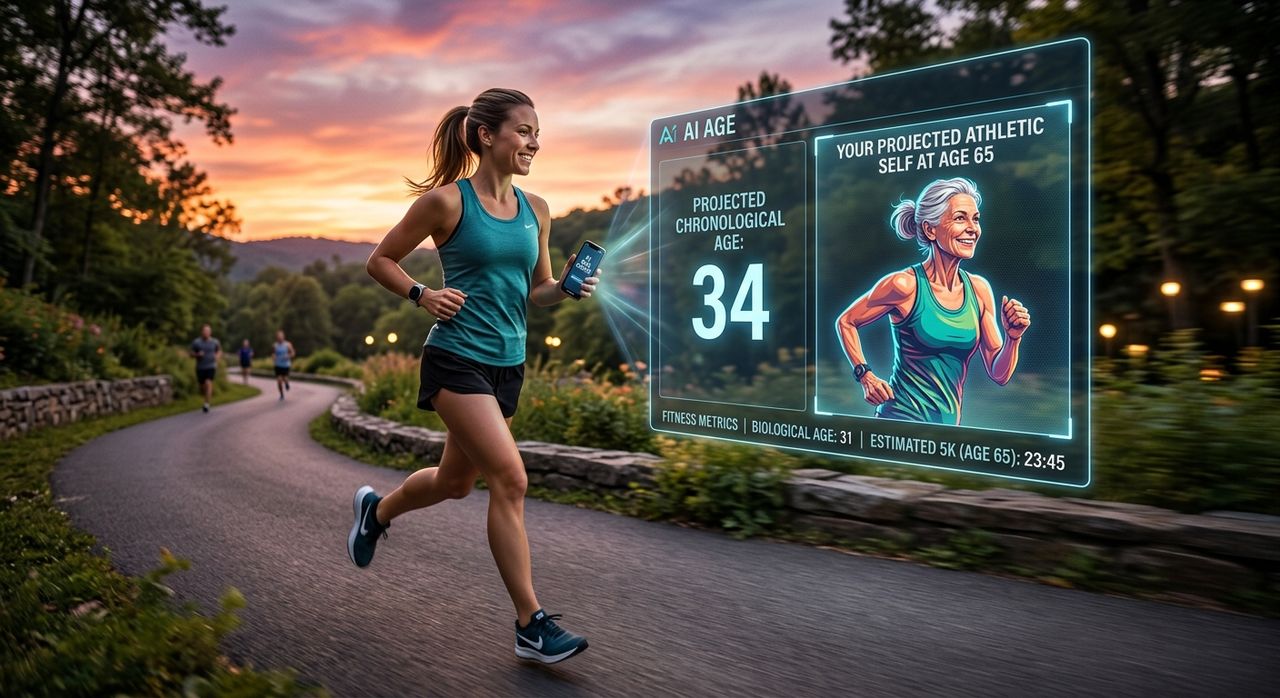
Here is where things get interesting and genuinely fun. A new category of AI tools can show you what you might look like decades from now. They use trained models to simulate aging on a photo, adjusting skin texture, facial structure, and other markers in ways that feel realistic enough to land emotionally.
Some runners have started using these tools during rest days as a motivational exercise. You upload a photo, apply an age filter to see your face at 65 or 75, and sit with that image for a moment. The person looking back at you is shaped, in part, by what you do between now and then.
It sounds lightweight. But the psychological effect is more interesting than you might expect. Seeing a plausible version of your older self activates the same future self-continuity research mentioned above. It makes the long-term goal feel personal and immediate, not abstract and distant.
Several runners in training communities have described this as the five-minute reset that gets them back on track after a motivational dip. Not because of the app itself, but because it forces a genuine moment of reflection that no training plan can schedule for you.
Tying Visualization Back to Your Training Plan
The key is not to treat this kind of tool as a gimmick. It works best when you follow the image with a concrete action. Look at your future self, then open your training log. Write down one thing you will do tomorrow that your future self will be glad you did. It might be a short easy run. It might be getting to bed earlier. It might simply mean not skipping the session you had scheduled.
The connection between visualization and behavior works through specificity. General motivation fades. Specific intentions stick.
Runners who build this kind of deliberate reflection into their off days, even just once a month, report that it changes how they approach the harder training weeks. The bigger picture stays visible. The effort feels worth it.
What Longevity Research Actually Tells Us About Consistency
The science keeps pointing in the same direction. Consistency over years matters far more than peak performance in any given season. A runner who logs moderate mileage steadily for twenty years is in a different health category than someone who pushes hard for two years and then stops.
This is partly why running attracts so many people in their 40s, 50s, and beyond. They have stopped chasing personal bests at every race and started running for a different set of reasons: the clarity it brings on a morning run, the way it regulates mood and energy, the knowledge that they are investing in how they will feel at 70.
These runners tend to have a more mature relationship with motivation. They have learned that it comes and goes, and that the trick is building habits and rituals that carry you through the low periods.
Age visualization is one of those rituals, emerging organically from a community that is thinking seriously about the long term.
Running at 70 Looks Like Running at 40 for Some People
There is real evidence for this. Studies tracking competitive masters runners, those competing in the 60-plus and 70-plus age brackets, show that their physiological profiles often resemble much younger recreational runners. Mitochondrial health, cardiac efficiency, and muscle fiber quality all respond to training stimulus in people well past what we once thought of as peak athletic age.
This does not mean anyone can run a marathon at 75 without consequences or careful preparation. It means the ceiling is higher than most people assume, and that the decisions you make in your 30s and 40s have a measurable impact on where you land decades later.
That is a powerful idea. And it deserves to be felt, not just understood.
Still Running at 75: The Vision Worth Protecting
Motivation is not a character trait. It is a resource, and like any resource, it needs to be replenished. The runners who stay consistent over decades are not people with superhuman willpower. They are people who have built systems that keep the reason for running visible and personal, even when the weather is bad and the legs are tired and the training plan feels like a burden.
Age visualization is one tool in that system. Longevity research gives you the rational argument. Future self psychology gives you the mechanism. And a five-minute experiment on a rest day can give you the emotional clarity that makes it all feel real again.
Run today. Your 75-year-old self is already glad you did.