Home>Training & Techniques>Training Plans>The Case for Printing Your Running Schedule Before Race Season Starts
Training Plans
The Case for Printing Your Running Schedule Before Race Season Starts
Published: August 3, 2026
Why printing your marathon training plan beats app reminders. Use periodization, a weekly planner, and a pen to build a race-ready habit.
(Many of the links in this article redirect to a specific reviewed product. Your purchase of these products through affiliate links helps to generate commission for Therunningadvisor.com, at no extra cost. Learn more)
Most runners spend hours researching training plans and then never look at them again. The plan gets buried inside an app, behind three taps and a login screen, and the motivation that felt so real in January quietly fades by March. There is a better way, and it costs nothing but a few minutes and a sheet of paper.
Key Takeaway: Training plans fail not because they are poorly designed but because they stay invisible. Periodization, the science of structuring training into deliberate phases, only works when you actually follow it. Printing your schedule and pinning it somewhere you see every day closes the gap between knowing your plan and living it. A physical calendar turns a vague intention into a daily visual commitment that is genuinely hard to ignore.
Why Periodization Deserves a Physical Home
Periodization is one of the most well-established ideas in sports science. It refers to organizing training into structured phases, typically a base-building phase, a build phase, a peak phase, and a taper, each with its own intensity and volume targets. The logic is sound: you stress the body progressively, then allow it to adapt before stressing it again. This is how elite marathon runners train, and it is how age-group athletes can get dramatically better results than riders who just head out the door and run whatever distance feels manageable that morning.
The problem is that periodization is inherently a long-horizon concept. A 16-week marathon build-up requires you to see the whole arc at once. You need to know that week four is a recovery week before you can appreciate why week five demands more mileage. You need to see the taper approaching to resist the panic-training instinct that hits most runners two weeks before a race. None of that context exists inside a single app notification that says “easy 5 miles today.” The message arrives without the surrounding structure that gives it meaning.
The Problem with Digital-Only Planning
Fitness apps are genuinely useful tools. They track your paces, log your history, and send reminders at set times. But they share one structural weakness: the plan lives behind a screen. You only see it when you deliberately go looking for it, which means you only engage with it when you are already motivated. The days you need the reminder most, the gray Tuesday mornings when the couch is winning, are precisely the days you are least likely to open the app.
There is solid psychological reasoning here. Research into habit formation and environmental design consistently shows that visible cues trigger behavior far more reliably than internal motivation. A training schedule pinned to your kitchen cabinet, or taped beside the bathroom mirror, works like a passive prompt. Every morning you brush your teeth, you see Thursday’s long run staring back at you. That low-friction visibility accumulates over a 16-week training block in ways that sporadic app-checking simply cannot match.
How to Map a Marathon Build the Old-Fashioned Way
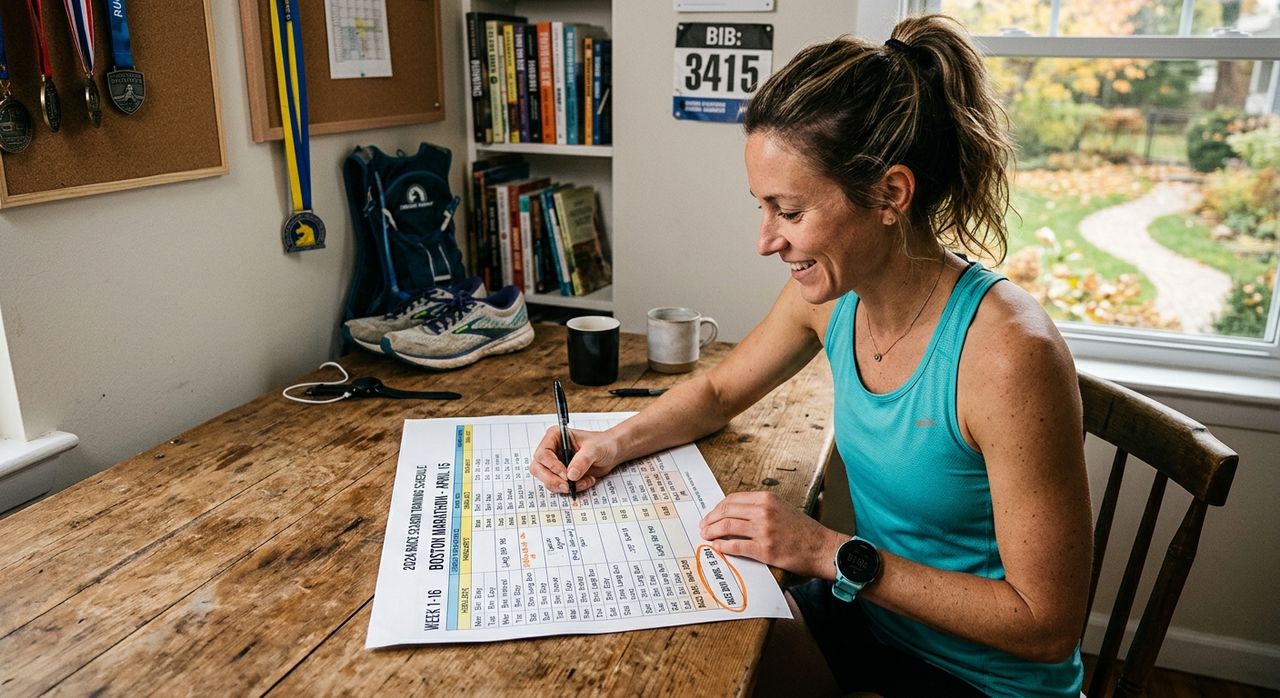
The actual process of printing and setting up a physical training schedule is straightforward, and it pays dividends for the full build-up. Start by printing a weekly planner that gives you a full grid of weeks from now until race day. You want enough space in each cell to write a mileage target, a workout type, and a short note.
From there, fill in the structure by hand. Write your long-run distance in the Sunday column for each week of the build. Mark your recovery weeks in a different color if you have one nearby. Add your midweek quality sessions, whether those are tempo runs, intervals, or strides, and keep the easy days clearly labeled so you do not accidentally turn a recovery jog into a hard effort. The act of writing this information by hand matters more than it sounds. Studies on learning and memory consistently find that handwriting encodes information more deeply than typing, and that same principle applies to planning. When you physically write “20-mile long run” in week 12, you are making a more concrete mental commitment than when a schedule populates automatically.
Hanging It Where You Cannot Miss It
Placement is everything. A printed schedule that lives in a folder is no better than an app you never open. The goal is to put it somewhere in your daily path where it cannot be avoided. The refrigerator door works for most people. So does the back of the front door, a spot you pass every time you leave the house. Some runners pin the plan above their desk so it is in peripheral vision during the workday.
The weekly format earns its place here because it shows you exactly where you are in the training arc at any given moment. At a glance, you can see whether this week is a build or a recovery, how many weeks remain until the race, and what the next big milestone is. That context is protective. It prevents both the overtraining that comes from losing track of the bigger picture and the undertraining that comes from not realizing how close the race actually is.
Staying Honest With a Pen
One of the underrated benefits of a printed schedule is the accountability that comes from marking it up. When you complete a run, cross it off or circle it. When you miss a session, leave the cell blank. Over the course of a training block, that visual record becomes a honest account of how consistent you have actually been, not the idealized version that lives in your head.
That honesty is useful. If you hit week eight and realize you have missed five of the last fourteen quality sessions, the paper tells you that clearly. You can adjust. Maybe the schedule was too aggressive. Maybe your life circumstances changed. A physical plan that has been written on, crossed out, and annotated is far more useful than a pristine digital log that hides your skipped sessions behind a calendar sync.
When to Print and How Far Out to Plan
The right time to print your schedule is before the training cycle starts, not after it has already begun. Printing mid-block means you are always catching up to a plan you feel behind on, which creates anxiety rather than confidence. Printing the full plan before week one gives you a sense of ownership over the whole journey from the start.
For a marathon, a 16 to 20 week block is the standard range. Print enough weeks to cover the full build, the taper, and then one week of post-race recovery so you can visually close the loop. That final week, already accounted for, serves as a reminder that rest after the race is part of the plan, not a failure of ambition.
The Ritual That Actually Gets You to the Start Line
Race preparation is partly physical and partly psychological. The physical part is what most runners focus on: the miles, the long runs, the strength work. But the psychological side, staying consistent, trusting the process, resisting the urge to do too much or too little, is what actually determines whether you show up to the start line healthy and ready.
A printed schedule hanging on your wall is one of the most reliable psychological anchors available to an endurance athlete. It makes the abstract concrete. It makes the invisible visible. It turns a 16-week commitment into a daily, tangible object that is part of your home environment rather than a screen you scroll past.
Before this race season starts, before you lace up for your first long run of the build, take 10 minutes to print your plan, fill it in by hand, and put it somewhere you cannot miss. The runners who make it to the finish line in good shape are usually not the ones with the most sophisticated apps. They are the ones who showed up, week after week, for the plan they could see.